Engineering reality Vs Digital Hype:Proposed BitChat app use during Uganda's electoral season
UGLugambo TeamJanuary 8, 20269 views
During periods of political uncertainty, there is often renewed interest in alternative communication technologies that claim to function without the internet. Recently, Bluetooth-based messaging applications such as BitChat have been presented as potential solutions in the event of an internet shutdown.
While these applications demonstrate innovative use of peer-to-peer technology, their real-world capabilities are frequently overstated. From a telecommunications engineering perspective, Bluetooth mesh communication has fundamental constraints that limit its effectiveness beyond small, localized scenarios.
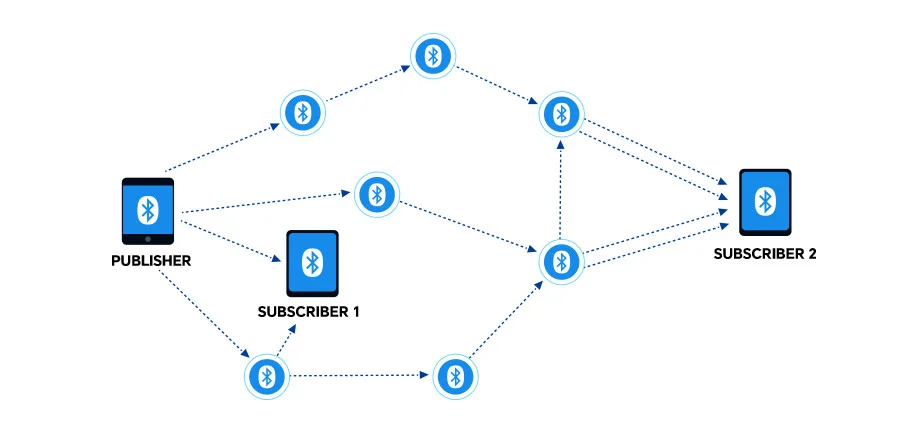
Bluetooth mesh messaging apps rely on Bluetooth Low Energy (BLE) to establish direct connections between nearby smartphones. Each phone acts not only as a user device but also as a relay, forwarding messages to the next nearby phone until the message reaches its destination. There are no base stations, no towers, and no centralized servers. Communication exists only because people are physically close to one another.
This architecture immediately introduces a hard physical limitation: range. In real-world conditions, Bluetooth connectivity between smartphones is typically limited to five to fifteen meters indoors and roughly twenty to fifty meters outdoors. In ideal open environments, communication may extend to around one hundred meters, but this is neither consistent nor reliable. Every message must therefore “hop” through a continuous chain of nearby users. If even one link in that chain is missing, the message goes no further.
For this reason, Bluetooth mesh networks require very high device density to function. Users must remain closely spaced, keep Bluetooth enabled, allow the application to run continuously, and maintain sufficient battery power. This combination of conditions can occur temporarily in dense crowds, such as rallies, campuses, or events. Outside such environments, maintaining uninterrupted connectivity becomes extremely difficult. In areas with lower population density or wider physical separation, the mesh quickly breaks into isolated pockets.
Human mobility further destabilizes Bluetooth mesh communication. Unlike engineered telecom networks, Bluetooth mesh systems have no fixed routing paths, no guaranteed delivery, and no persistent backbone. As people move, enter buildings, travel between locations, or simply turn off Bluetooth to save battery, routes disappear instantly. Messages may be delayed, duplicated, or lost entirely. This makes Bluetooth mesh inherently transient and unsuitable for sustained communication across large or dispersed areas.
Battery consumption is another practical limitation. Continuous Bluetooth scanning and message relaying place a noticeable load on smartphone batteries. Over extended periods, users naturally prioritize keeping their phones operational by disabling Bluetooth or closing background applications. As participation drops, the mesh weakens further, creating a feedback loop that accelerates network collapse. In practice, even well-formed Bluetooth meshes tend to degrade within hours rather than persist over long durations.
Security and information integrity also become challenges as scale increases. Bluetooth mesh applications typically lack centralized authentication, identity verification, reliable time synchronization, or content moderation. While this may be acceptable for small peer groups, it becomes problematic when many users are involved. The absence of trust anchors increases exposure to misinformation, message replay, duplication, and false alerts. In sensitive contexts, these weaknesses can undermine confidence in the information being shared.
It is important to distinguish between technical possibility and practical viability. Bluetooth mesh communication does work, but only within specific boundaries. It is effective for short-range, localized coordination where users are densely packed and communication needs are simple and temporary. It was never designed to replace engineered telecommunications systems that rely on licensed spectrum, managed infrastructure, and nationwide backhaul networks.
Some alternative offline technologies scale better in terms of distance. For example, **LoRa-based peer-to-peer systems can transmit messages over several kilometers without internet access. However, these systems support extremely low data rates, require dedicated hardware, and are unsuitable for high-volume or real-time communication. Even these technologies are best viewed as complementary tools rather than substitutes for mobile and internet networks.
The key misunderstanding around Bluetooth mesh apps lies in assuming that removing infrastructure also removes physical constraints. In reality, the opposite is true. Without towers, fiber, or satellites, communication becomes entirely dependent on human proximity and behavior. A technology that relies on people standing close together cannot deliver consistent communication across wide geographic areas or diverse population distributions.
From a technical standpoint, Bluetooth mesh messaging should therefore be understood as a situational solution, not a general-purpose communication platform. It excels in small, dense, short-lived environments and fails gracefully outside them. Recognizing these limits is not a criticism of the technology but a necessary step toward realistic expectations and responsible communication planning.
In conclusion, Bluetooth mesh applications offer an innovative approach to offline, local messaging, but their usefulness is inherently bounded by physics, human behavior, and power constraints. They are valuable tools in specific circumstances, yet they cannot provide sustained, large-scale communication coverage.
Bluetooth mesh messaging apps rely on Bluetooth Low Energy (BLE) to establish direct connections between nearby smartphones. Each phone acts not only as a user device but also as a relay, forwarding messages to the next nearby phone until the message reaches its destination. There are no base stations, no towers, and no centralized servers. Communication exists only because people are physically close to one another.
This architecture immediately introduces a hard physical limitation: range. In real-world conditions, Bluetooth connectivity between smartphones is typically limited to five to fifteen meters indoors and roughly twenty to fifty meters outdoors. In ideal open environments, communication may extend to around one hundred meters, but this is neither consistent nor reliable. Every message must therefore “hop” through a continuous chain of nearby users. If even one link in that chain is missing, the message goes no further.
For this reason, Bluetooth mesh networks require very high device density to function. Users must remain closely spaced, keep Bluetooth enabled, allow the application to run continuously, and maintain sufficient battery power. This combination of conditions can occur temporarily in dense crowds, such as rallies, campuses, or events. Outside such environments, maintaining uninterrupted connectivity becomes extremely difficult. In areas with lower population density or wider physical separation, the mesh quickly breaks into isolated pockets.
Human mobility further destabilizes Bluetooth mesh communication. Unlike engineered telecom networks, Bluetooth mesh systems have no fixed routing paths, no guaranteed delivery, and no persistent backbone. As people move, enter buildings, travel between locations, or simply turn off Bluetooth to save battery, routes disappear instantly. Messages may be delayed, duplicated, or lost entirely. This makes Bluetooth mesh inherently transient and unsuitable for sustained communication across large or dispersed areas.
Battery consumption is another practical limitation. Continuous Bluetooth scanning and message relaying place a noticeable load on smartphone batteries. Over extended periods, users naturally prioritize keeping their phones operational by disabling Bluetooth or closing background applications. As participation drops, the mesh weakens further, creating a feedback loop that accelerates network collapse. In practice, even well-formed Bluetooth meshes tend to degrade within hours rather than persist over long durations.
Security and information integrity also become challenges as scale increases. Bluetooth mesh applications typically lack centralized authentication, identity verification, reliable time synchronization, or content moderation. While this may be acceptable for small peer groups, it becomes problematic when many users are involved. The absence of trust anchors increases exposure to misinformation, message replay, duplication, and false alerts. In sensitive contexts, these weaknesses can undermine confidence in the information being shared.
It is important to distinguish between technical possibility and practical viability. Bluetooth mesh communication does work, but only within specific boundaries. It is effective for short-range, localized coordination where users are densely packed and communication needs are simple and temporary. It was never designed to replace engineered telecommunications systems that rely on licensed spectrum, managed infrastructure, and nationwide backhaul networks.
Some alternative offline technologies scale better in terms of distance. For example, **LoRa-based peer-to-peer systems can transmit messages over several kilometers without internet access. However, these systems support extremely low data rates, require dedicated hardware, and are unsuitable for high-volume or real-time communication. Even these technologies are best viewed as complementary tools rather than substitutes for mobile and internet networks.
The key misunderstanding around Bluetooth mesh apps lies in assuming that removing infrastructure also removes physical constraints. In reality, the opposite is true. Without towers, fiber, or satellites, communication becomes entirely dependent on human proximity and behavior. A technology that relies on people standing close together cannot deliver consistent communication across wide geographic areas or diverse population distributions.
From a technical standpoint, Bluetooth mesh messaging should therefore be understood as a situational solution, not a general-purpose communication platform. It excels in small, dense, short-lived environments and fails gracefully outside them. Recognizing these limits is not a criticism of the technology but a necessary step toward realistic expectations and responsible communication planning.
In conclusion, Bluetooth mesh applications offer an innovative approach to offline, local messaging, but their usefulness is inherently bounded by physics, human behavior, and power constraints. They are valuable tools in specific circumstances, yet they cannot provide sustained, large-scale communication coverage.